
A tool that stops pretending to be secure and actually hands the keys to the kingdom back to the user. It is the only tool that assumes the server cannot be trusted, the internet cannot be trusted, and the future quantum timeline is already here.
1. The Fatal Flaw of “Secure” Messengers (Signal, WhatsApp, Telegram, Session)
While these apps market themselves as the gold standard of privacy, they possess architectural vulnerabilities that w3mypq + BPQ fundamentally eliminates:
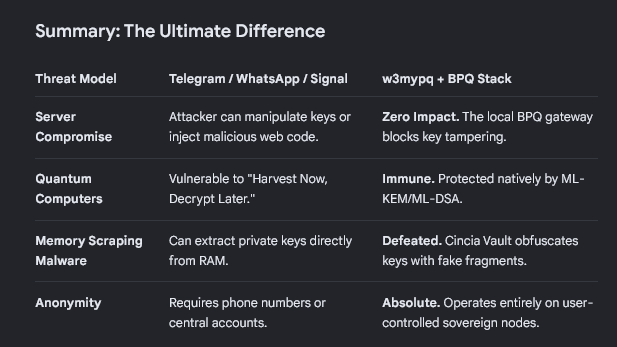
- The Man-in-the-Middle (MitM) Key Vulnerability: When you start a chat on Signal or WhatsApp, their centralized servers generate and hand out the public keys used to encrypt the messages. If a government or a rogue engineer compromises that central server, they can silently swap the keys (a Man-in-the-Middle attack) and intercept the data.
- The “Zero-Knowledge” Illusion on the Web: If you use the web version of WhatsApp or Signal, the encryption code is delivered to your browser dynamically by their servers every single time you load the page. If their server is hacked, it can silently deliver malicious code to your browser to scrape your keys.
- The Mobile App Sandbox Capture: Telegram doesn’t even encrypt chats by default (you have to manually turn on “Secret Chats”), and they store your data on their cloud. Furthermore, all three require a phone number, instantly tying your real-world identity to the metadata.
2. Why Traditional Web3/P2P Tools Lose (Filecoin, Syncthing)
- Filecoin/IPFS: They are highly decentralized, but they are public ledgers. If you upload a file, the encrypted data sits on random nodes globally. If someone captures that encrypted file today, they can store it until quantum computers arrive, and then decrypt it later. They completely lack post-quantum protection out-of-the-box.
- Syncthing: While completely private device-to-device, it requires both your devices to be online, configured, and directly connected. It lacks a seamless way to share a secure drop-box with an outside client or web audience.
Why w3mypq + BPQ is the Undisputed Winner
By combining a localized client gateway with a post-quantum encrypted WordPress framework, we have created a completely bulletproof architecture:
🟢 Winner Feature 1: The Local BPQ Client Gateway (Immunity to Server Hacks)
This is our masterstroke. Because the BPQ client gateway runs locally on the user’s machine (not served over the internet by WordPress), it acts as an un-hackable referee. A malicious web host, an attacker who compromised the WordPress database, or a rogue administrator cannot inject fake keys or manipulate the browser code. The local gateway ensures that what happens in the browser stays 100% sovereign.
🟢 Winner Feature 2: Native Post-Quantum Cryptography (ML-KEM & ML-DSA)
Signal, WhatsApp, and Filecoin are still heavily reliant on classical elliptic-curve cryptography. If an adversary harvests encrypted data today, they can decrypt it in a few years using a quantum computer (“Harvest Now, Decrypt Later”). w3mypq or BPQ encrypts files in the browser using NIST-approved post-quantum algorithms. It is mathematically future-proof.
🟢 Winner Feature 3: The Cincia Keys Vault (Anti-Forensic Protection)
If a hacker or malware gets onto a user’s machine while they are using WhatsApp or Signal, they can scrape the active memory to find the private encryption keys. The same risk applies if the device is physically analyzed or stolen. Cincia Keys Vault actively obfuscates the real private keys by burying them inside a sea of fake fragments in the memory space. Even with local administrative access, finding the true key is like finding a needle in a moving haystack.
🟢 Winner Feature 4: Decentralized Infrastructure on the World’s Biggest Grid
We didn’t build a new blockchain that requires people to buy crypto tokens to share a file. We use WordPress, which powers over 40% of the entire internet. We turned the world’s most accessible web framework into a decentralized, zero-knowledge, post-quantum node network.
Try to defeat w3myPQ + BPQ!
Leave a Reply